Pehla Shahi Snan
First Royal Bath · TBC — 2027 (Simhastha)
The opening royal bathing date. Akharas (religious orders) take the holy dip in a prescribed sequence. The most visually significant day of the Kumbh Mela.
Highest Crowd
The Nashik Kumbh Mela 2027 (Simhastha) is held every 12 years on the banks of the Godavari river. Expected to attract over 30 million pilgrims. Shahi Snan dates draw tens of millions in a single day. All transport and accommodation fills months in advance. Book your group transport now.
Every 12 Years
Next: Nashik Simhastha 2027
30 Million+ Pilgrims
Expected over full duration
Godavari River
Ramkund Nashik · Trimbakeshwar
Transport Fills Early
Book 6–12 months ahead
We Operate in Nashik
Local fleet · All vehicle sizes
All Group Sizes
4-seater to 70-seater coaches
About the Event
The Kumbh Mela at Nashik — called Simhastha — is held every 12 years when Jupiter (Brihaspati) enters the Leo (Simha) zodiac sign. It is one of four Kumbh Mela sites in India — the others being Prayagraj (Allahabad), Haridwar, and Ujjain. The Nashik Kumbh is unique because it is held across two locations simultaneously — the primary site at Ramkund on the Godavari in Nashik city, and at Trimbakeshwar, the Jyotirlinga temple 28 km away at the source of the Godavari.
The Shahi Snan (royal bathing) dates are the most significant moments of the Kumbh Mela — these are specific auspicious dates when a ritual bath in the Godavari is considered to wash away generations of sin and accelerate spiritual liberation. On Shahi Snan days, tens of millions of pilgrims converge on the Godavari ghats simultaneously. Every road, railway line, and bus route to Nashik operates at absolute maximum capacity — and beyond it.
The logistical reality of Kumbh Mela 2027 for anyone planning to attend: every vehicle, hotel room, and guest house within 50 km of Nashik is fully booked near the Shahi Snan dates, typically 6 to 12 months in advance. Arriving without pre-booked transport means arriving without transport. We have operated vehicles during the Nashik Kumbh Mela from our base in Igatpuri (55 km from Nashik) since 2015.
The Nashik Simhastha 2015 attracted 37.5 million pilgrims — more than the combined population of Maharashtra's top 5 cities. The 2027 edition is expected to exceed that figure.
Key Numbers
37.5M
Pilgrims at 2015 Nashik Kumbh Mela
12 yrs
Frequency — Jupiter enters Leo
2 Sites
Nashik Ramkund + Trimbakeshwar
3
Major Shahi Snan bathing dates
28 km
Nashik to Trimbakeshwar Jyotirlinga
55 km
Igatpuri to Nashik — our base
Royal Bathing Dates
The Shahi Snan (royal bathing) are the peak dates of the Kumbh Mela when a ritual bath in the Godavari is considered most auspicious. These dates see the highest pilgrim concentration — tens of millions arrive simultaneously. Transport must be booked months before these specific dates.
First Royal Bath · TBC — 2027 (Simhastha)
The opening royal bathing date. Akharas (religious orders) take the holy dip in a prescribed sequence. The most visually significant day of the Kumbh Mela.
Second Royal Bath · TBC — 2027 (Simhastha)
The second major royal bathing date — considered equally auspicious for ordinary pilgrims. Typically falls on a specific Purnima or Ekadashi date within the Kumbh period.
Third Royal Bath · TBC — 2027 (Simhastha)
The final Shahi Snan of the 2027 Nashik Kumbh Mela. After this date, pilgrim numbers begin to reduce. The Kumbh period continues for several weeks beyond the final Shahi Snan.
Non-Shahi Days · Throughout Kumbh 2027
Regular pilgrims bathe throughout the entire Kumbh Mela period — not only on Shahi Snan days. Non-Shahi days are less crowded and transport is easier to arrange.
Previous Reference · July–September 2015
The 2015 Nashik Simhastha ran from July to September 2015 with three major Shahi Snan dates. Pehla Shahi Snan (July 14) attracted 7–8 million pilgrims in a single day.
Transport Reality · Register now for 2027
All vehicles, hotels, and guest houses within 50 km of Nashik fill completely near Shahi Snan dates. Waiting until 3–6 months before means no vehicle availability at any price.
Transport Planning
The Nashik Kumbh Mela is unlike any event most people have experienced. The scale creates logistical realities that require planning 6 to 12 months ahead — not 2 to 3 weeks.
Total fleet is finite — demand is unlimited
The total number of vehicles in Nashik, Igatpuri, and surrounding districts is a fixed number. When 30 million pilgrims need transport, every vehicle of every size is already allocated months before the event.
Shahi Snan dates see the largest surge
Shahi Snan dates attract millions of additional pilgrims who only attend for that specific day. These pilgrims compete for the same finite vehicle pool as those already in Nashik for the full duration.
Accommodation scarcity forces out-of-city stays
Most Kumbh Mela pilgrims cannot stay in Nashik itself — hotels are full. They stay in Igatpuri, Ghoti, Sinnar, or Ozar and commute. This creates massive demand for transport from 50-100 km away.
Online apps stop working at Kumbh scale
Aggregator apps and surge pricing cannot solve a Kumbh Mela transport problem. The apps are designed for normal city demand. At Kumbh scale, pre-arranged ground operator relationships are the only reliable option.
Practical Guide
Based on what we observed during the 2015 Nashik Simhastha from our operations in Igatpuri. Nothing in a general guide will prepare you for the scale — but this operational knowledge will.
Transport Reality
All roads to Nashik from Mumbai and Pune are bumper-to-bumper from 4am on Shahi Snan days. NH3 (Kasara Ghat) is congested for 12+ hours — plan to depart Igatpuri before 3am. Parking in Nashik city is not available within 5 km of Ramkund on Shahi Snan days. Taxis and apps do not function at Kumbh scale — pre-arranged transport only. Trains are completely full — book train tickets 4 months in advance.
Accommodation Reality
Hotels in Nashik city are fully booked near Shahi Snan dates — often 12 months ahead. Look for accommodation in Igatpuri (55 km), Sinnar (30 km), Ozar (25 km), or Ghoti (40 km). Tent/camping accommodation is set up by the government at designated areas during the Kumbh period. Many pilgrims arrive and return in a single day — pre-planned transport makes this possible. Book accommodation with free cancellation — dates may shift when official schedule is announced.
Darshan and Bathing
Bathing occurs at Ramkund in Nashik and Kushavarta Kund in Trimbakeshwar. Shahi Snan sequence: Akharas (religious orders) bathe first in a prescribed order. General pilgrims bathe after the Akhara processions — typically from mid-morning. Trimbakeshwar Jyotirlinga darshan on Shahi Snan days requires arriving before 5am. Carry only a small bag — large luggage cannot be managed in the crowd.
Location Guide
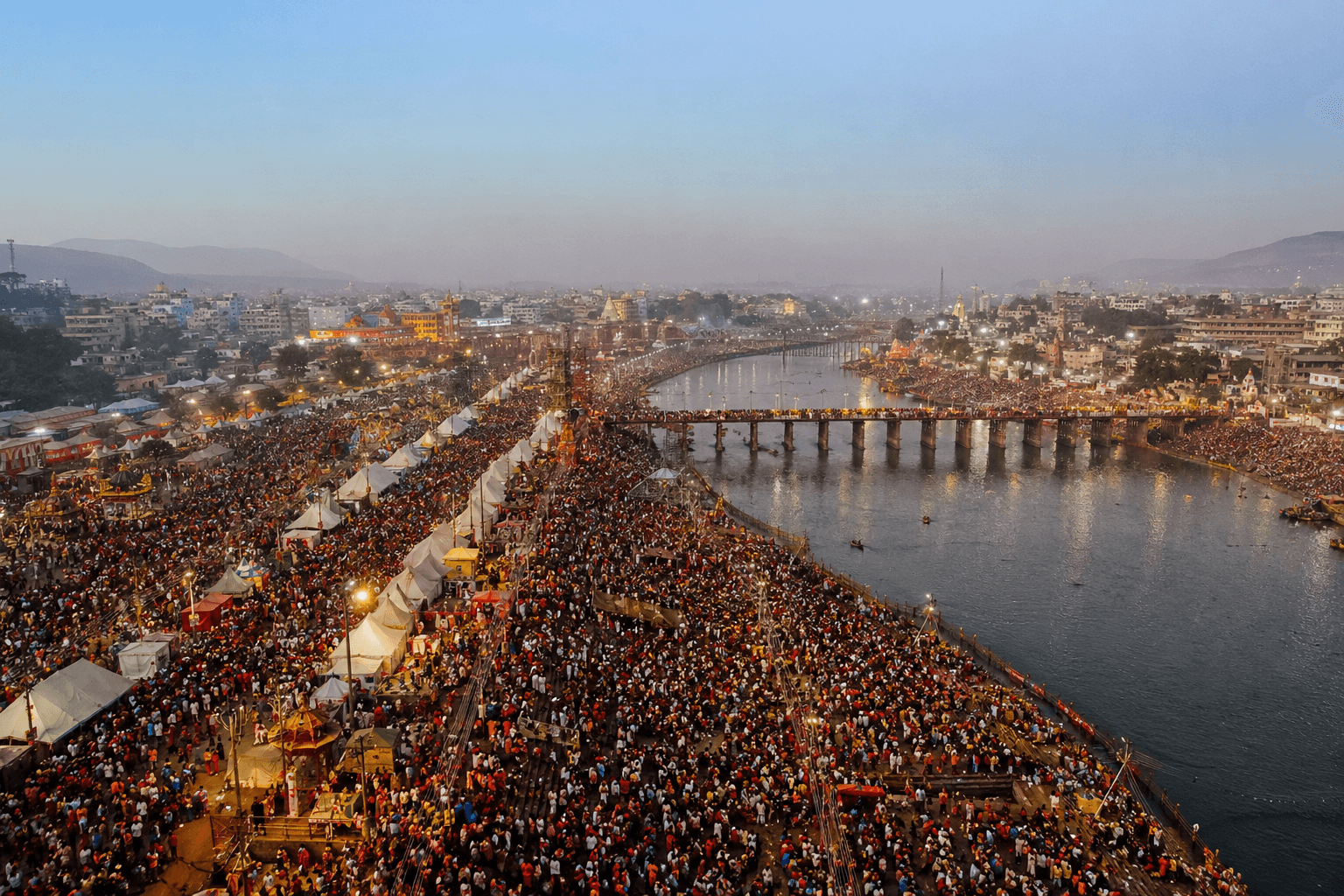
Ramkund Ghat, Nashik — Primary Kumbh Mela site
Also at Kushavarta Kund, Trimbakeshwar — 28 km
The Nashik Simhastha is unique among all Kumbh Melas in having two primary bathing sites 28 km apart. Ramkund in Nashik is the main site for general pilgrims. Trimbakeshwar — the Jyotirlinga at the source of the Godavari — is the site for Shahi Snan by the Akharas and for pilgrims specifically seeking the Jyotirlinga darshan.
Common Questions
The Nashik Kumbh Mela 2027 (Simhastha) is expected to be held in 2027, with exact dates to be announced by the Maharashtra State Government. The event is held every 12 years when Jupiter enters the Leo zodiac sign. The previous Nashik Kumbh Mela was held from July to September 2015.
Simhastha is the name for the Kumbh Mela held in Nashik and Trimbakeshwar, Maharashtra. It occurs every 12 years on the banks of the Godavari river. Simhastha refers to Jupiter's position in Simha (Leo). The event includes Shahi Snan (royal bathing) on auspicious dates when millions of pilgrims bathe in the Godavari simultaneously.
The 2015 Nashik Kumbh Mela attracted approximately 37.5 million pilgrims over the full event duration. The 2027 edition is expected to attract a similar or larger number. On the first Shahi Snan day of the 2015 Kumbh Mela, an estimated 7 to 8 million pilgrims arrived in Nashik in a single day.
Book transport for Nashik Kumbh Mela 2027 as early as possible — ideally 6 to 12 months in advance of the Shahi Snan dates. All vehicles in and around Nashik are fully allocated near these dates. WhatsApp or call us to register with your group size, preferred dates, and pickup location. No advance payment is required to register.
The Nashik Kumbh Mela (Simhastha) is held at two sites — Ramkund in Panchavati, Nashik city (primary bathing ghat on the Godavari), and Kushavarta Kund in Trimbakeshwar (28 km from Nashik, at the source of the Godavari). The Shahi Snan processions of the Akharas take place at both locations.
Yes — a day trip from Mumbai is possible and is the most common way for non-pilgrims to attend the Kumbh Mela. The key is pre-arranged transport. A 3am departure from Mumbai puts you in Nashik before the morning crowd builds. On Shahi Snan days, even the return journey takes 4 to 5 hours.
Explore More
Shirdi, Ashtavinayak, Trimbakeshwar, Chardham — complete pilgrimage hub.